

Category: Course Syllabus

share market course in chennai

Top 5 Share Market Classes in Chennai (2025 Update)

If you are looking for the top share market classes in Chennai in 2025, the best options include Classroom of Traders, Nifty Trading Academy, BSE Institute Limited, Online Trading Academy, and NSE Academy. These institutes provide structured stock market classes in Chennai that cover beginner to advanced trading, live market practice, and certifications, making them the most trusted choices for anyone serious about learning trading and investing.

Top Share Market Classes in Chennai in 2025


Introduction: Why Stock Market Courses Matter in 2025

Trading in the stock market is no longer limited to financial professionals. In 2025, more individuals in Chennai are exploring trading and investing as career paths and secondary income sources. With India’s financial markets expanding, the demand for stock market classes in Chennai has surged.

The right training institute helps you:

  • Understand the fundamentals of equity, derivatives, and forex.
  • Learn chart reading, technical analysis, and trading psychology.
  • Apply strategies in real markets with confidence.
  • Avoid common mistakes beginners make.

This blog reviews the top 5 share market classes in Chennai, comparing their features, course structure, fees, and benefits.


1. Classroom of Traders – Award-Winning Training Institute in Chennai

share market classes in Chennai

Why Choose Classroom of Traders?

Classroom of Traders is one of Chennai’s most trusted stock market training institutes. Founded by award-winning trader Mr. Fredrik, the institute focuses on practical, real-world training.

share market classes in Chennai


Classroom of Traders is one of the leading stock market training institutes in Chennai, known for transforming beginners into confident traders. The institute is powered by expert mentors like Mr. Fredrick, an award-winning trader and educator, who designs practical strategies tailored for real-world markets. Classroom of Traders offers a structured learning path that covers technical analysis, candlestick patterns, intraday strategies, risk management, and live trading practice. Their speciality lies in blending theory with hands-on exposure, ensuring students not only understand concepts but also apply them successfully in the stock market

share market classes in Chennai

Key Features

  • Beginner to Advanced Levels: Covers basics to advanced strategies like Elliott Wave, Fibonacci, and price action.
  • Hands-On Training: Live trading practice on NSE and global markets.
  • Career-Oriented Approach: Suitable for beginners, job seekers, and professionals.
  • Free Workshops: Introductory sessions for new learners.
  • Updated Syllabus (2025): Incorporates AI-based trading tools and algo-trading basics.

Course Highlights

  • Duration: 1–3 months (flexible batch timings).
  • Fees: Moderate, with installment options.
  • Certification: Industry-recognized completion certificate.

share market classes in Chennai
What Students Say About the Best Share Market Classes in Chennai

Classroom of Traders Course Syllabus

  1. Introduction to Stock Market
  2. Technical Analysis Foundations
  3. Advanced Technical Strategies
  4. Derivatives & Options Trading
  5. Intraday & Swing Trading Strategies
  6. Risk Management & Psychology
  7. Live Market Training
  8. Career & Certification Support

Get a free audit report and strategy plan for this course.

Best For: Students looking for an affordable yet high-quality share market course in Chennai with personalized mentorship.

Social Profiles of classroom of traders :

Contact Details

Address: 18 A, VOC St, Om Sakthi Nagar, Kaikankuppam, Valasaravakkam, Chennai, Tamil Nadu 600087
Phone: 99962234448
Email:info@fredrikedge.com
Website:https://classroomoftraders.com/


2. Nifty Trading Academy (NTA)

stock market classes in chennai

Why NTA?

Nifty Trading Academy is a leading stock market coaching center with a strong presence across India.

Key Features

  • Nifty & Intraday Focus: Specialized modules on intraday trading and index analysis.
  • Practical Learning: Live market case studies.
  • Lifetime Mentorship: Continued support after course completion.

Course Highlights

  • Covers technical indicators, candlestick patterns, and risk management.
  • Online + offline classes available in Chennai.
  • Fees: Mid to premium range.

Best For: Traders who want strong training in intraday trading strategies.

Social Profiles :

Contact Details

Phone: 097247 95247
Email:niftytradingacademy@ymail.com
Website:https://www.niftytradingacademy.com/


3. BSE Institute Limited (Chennai Branch)

share market course in chennai

Why BSE Institute?

Being a subsidiary of the Bombay Stock Exchange, BSE Institute offers world-class financial education.

Key Features

  • Industry-Backed Courses: Designed by experts with market experience.
  • Certifications: Recognized by employers globally.
  • Focus on Investment Banking: Beyond trading, covers corporate finance and compliance.

Course Highlights

  • Equity, derivatives, mutual funds, and regulatory framework.
  • Blended learning: Classroom + e-learning.
  • Premium fees, but high ROI due to brand recognition.

Best For: Students who want a recognized certification for a career in finance and markets.

Social Profiles :


4. Online Trading Academy (OTA) – Chennai

share trading classes in chennai

Why OTA?

Online Trading Academy has an international presence with centers in Chennai.

Key Features

  • Global Curriculum: Covers Indian and international markets.
  • Practical Labs: Simulated trading environments.
  • Focus on Lifestyle Trading: Teaches both full-time and part-time trading methods.

Course Highlights

  • Modules include equities, forex, futures, and options.
  • Online + classroom flexibility.
  • Premium fee structure.

Best For: Working professionals seeking global-standard share trading classes in Chennai.

Social Profiles :


5. NSE Academy

share market classes in chennai

Why NSE Academy?

National Stock Exchange (NSE)’s training wing provides professional-grade courses.

Key Features

  • SEBI-Recognized Courses: Aligned with regulatory frameworks.
  • Industry Trainers: Led by financial experts.
  • Certifications: Highly valued in the finance industry.

Course Highlights

  • Modules in equity research, derivatives, risk management, and algo-trading.
  • Blended online + offline options.
  • Fees: Moderate to premium.

Best For: Students aiming for long-term careers in trading and financial services.

Social Profiles :


Why Share Market Classes in Chennai Are Gaining Popularity

Over the past few years, more people have realized that trading is not just for finance professionals. With rising interest in stock trading training in Chennai, both beginners and working professionals are enrolling in structured courses. These programs simplify complex topics like technical analysis, options trading, and risk management into easy-to-learn modules. The availability of share market classes in Chennai in both Tamil and English has also expanded access, making financial education inclusive and practical for the city’s diverse population.


Benefits of Joining the Best Stock Market Course in Chennai

Enrolling in a share market course in Chennai provides more than just textbook knowledge. Students gain hands-on exposure to live market conditions, mentorship from experienced traders, and industry-recognized certifications that open career opportunities. The city’s top trading institutes in Chennai also integrate AI-powered tools and algorithmic trading strategies into their 2025 curriculum, preparing learners for the future of financial markets. Whether your goal is intraday trading, long-term investing, or building a career in finance, the right stock market classes in Chennai can set the foundation for success.


Comparison Table: Top 5 Share Market Classes in Chennai (2025)

InstituteFocus AreaDurationModeFeesBest For
Classroom of TradersPractical + Advanced Strategies1–3 monthsOffline/OnlineModerateBeginners + Professionals
Nifty Trading AcademyIntraday & Nifty Trading2–3 monthsBothMid–PremiumIntraday Traders
BSE Institute LimitedFinance + Trading3–6 monthsHybridPremiumCareers in Finance
Online Trading AcademyGlobal + Multi-Asset Training3–6 monthsBothPremiumProfessionals, International Focus
NSE AcademySEBI-Recognized Programs3–12 monthsHybridMid–PremiumLong-Term Career in Finance & Markets

Why Chennai is Emerging as a Trading Education Hub

  • Growing number of retail traders in Tamil Nadu.
  • Chennai’s financial literacy initiatives.
  • Proximity to tech hubs driving interest in algo-trading.
  • Institutes offering courses in Tamil + English for wider reach.

Conclusion

In 2025, learning stock market trading in Chennai is easier and more structured than ever. Whether you are a beginner or aiming for a career in finance, these top 5 share market classes in Chennai provide the skills, mentorship, and certifications you need.

If you want a practical, affordable, and result-driven share market course in Chennai, Classroom of Traders is a strong choice. For global exposure, institutes like BSE Institute, NSE Academy, and OTA also deliver excellent value.


FAQs – Share Market Classes in Chennai (2025)

1. Which is the best institute for share market classes in Chennai?

The best institute depends on your goals. For practical training, Classroom of Traders is highly recommended. For recognized certifications, BSE Institute and NSE Academy are strong choices.

2. What is the average fee for stock market classes in Chennai?

The average fee ranges from ₹15,000 to ₹80,000, depending on the course level and institute.

3. Can beginners join share market courses in Chennai?

Yes. Most institutes in Chennai have beginner-friendly modules that start with basics like stock market terms, trading accounts, and chart reading.

4. Do share market classes in Chennai include live trading practice?

Yes, leading institutes like Classroom of Traders and Nifty Trading Academy offer live market sessions along with theory.

5. How long does a typical stock market course last in Chennai?

Courses range from 1 month to 12 months. Short-term courses focus on basics, while longer programs cover advanced strategies and certifications.

6. Are stock market courses in Chennai available online?

Yes. Many institutes offer hybrid learning, with both classroom and online training options.

7. What topics are covered in a share market course in Chennai?

Common topics include fundamentals, technical analysis, candlestick charts, derivatives, intraday trading, and risk management.

8. Do these classes cover algo-trading and AI tools in 2025?

Yes. Institutes like NSE Academy and Classroom of Traders have added modules on algo-trading and AI-powered analysis.

9. Can I take a share market course in Chennai in Tamil?

Some institutes provide bilingual training in Tamil and English, making it easier for regional learners.

10. Are there free share trading classes in Chennai?

Yes. Certain institutes offer free workshops or demo sessions before enrolling in paid courses.

11. Do stock market courses in Chennai guarantee jobs?

No course can guarantee a job, but institutes like BSE Institute and NSE Academy provide certifications that improve employability.

12. What is the difference between online and offline share market classes in Chennai?

Offline classes offer face-to-face mentorship, while online classes provide flexibility. Many institutes now use hybrid models for better convenience.

13. Is prior finance knowledge required for share market training?

No. Courses are designed for beginners with no prior finance or trading background.

14. Do these classes cover intraday trading strategies?

Yes. Institutes such as Nifty Trading Academy specialize in intraday and short-term trading techniques.

15. How do I choose the best share market course in Chennai?

Check the course content, trainer experience, practical training options, certification value, fees, and student reviews before enrolling.

16. Are international certifications available from Chennai-based institutes?

Yes. Institutes like BSE Institute and OTA (Online Trading Academy) provide globally recognized certifications.

17. Can working professionals join evening or weekend share market classes in Chennai?

Yes. Flexible batch timings are available, including evening and weekend sessions for professionals.

18. Do these courses provide lifetime mentorship or support?

Some institutes, like Nifty Trading Academy, provide lifetime mentorship and post-course guidance.

19. What career options open after completing a stock market course in Chennai?

You can work as a trader, equity analyst, financial advisor, portfolio manager, or research associate in finance firms.

20. Which share market course in Chennai is best for long-term investors?

Classroom of Traders and NSE Academy offer modules on investment strategies, portfolio building, and wealth management, suitable for long-term investors.

educational routes for trading success

Best Educational Routes for Trading Success in 2025

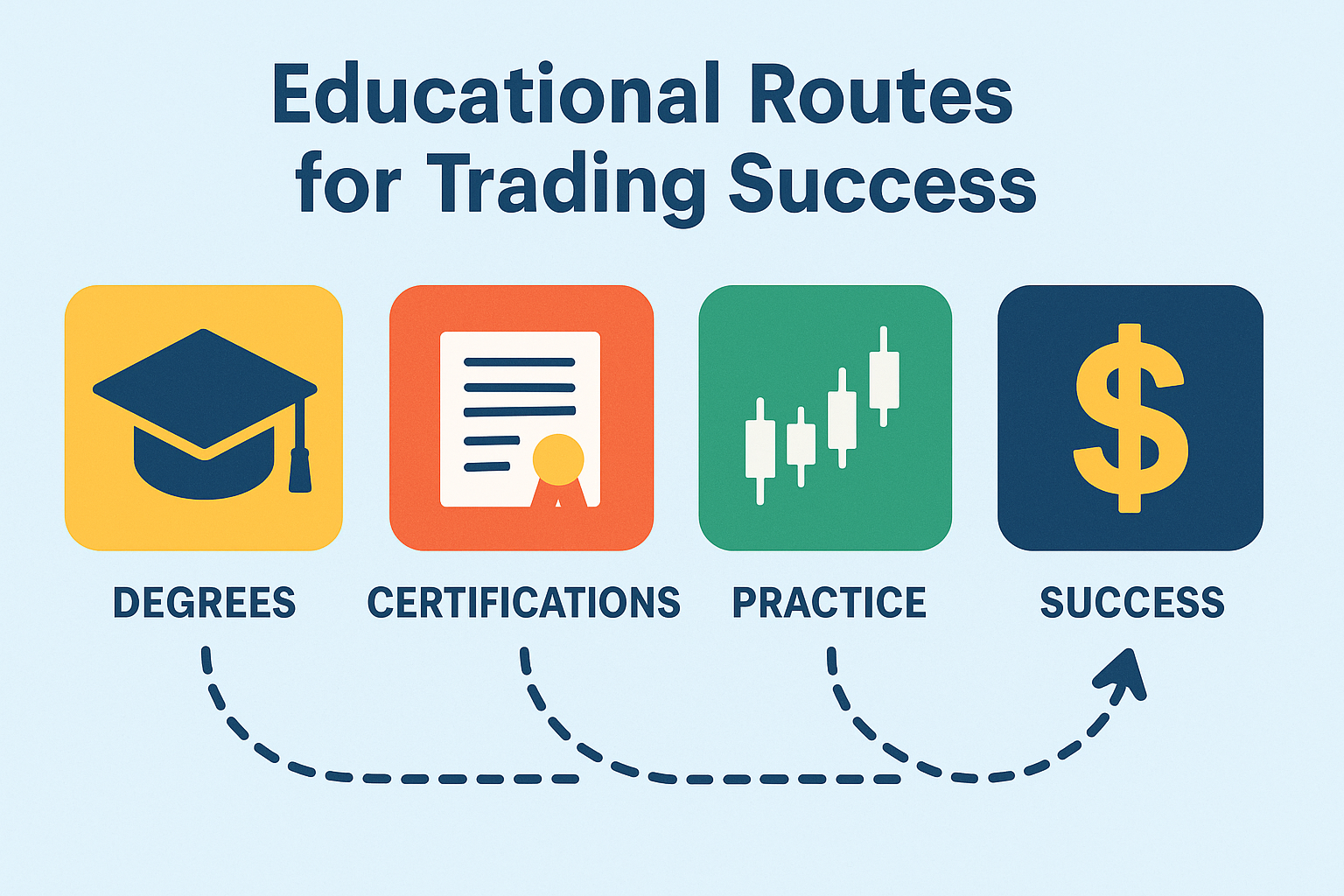
Educational routes for trading success in 2025 include structured finance or economics degrees, specialized stock market training, online trading classes, and hands-on practice with simulators. These routes give aspiring traders the knowledge, discipline, and practical skills they need to succeed in today’s fast-moving markets, making them the most effective paths for building a long-term trading career.

best stock market training institute in chennai
A clear roadmap helps traders choose the right learning path

Why Education Matters in Trading

Trading is not just about buying low and selling high. It requires discipline, risk management, and a solid understanding of how markets move. Without the right education, traders often make emotional decisions that lead to losses. This is why structured educational routes for trading success are so important. They provide a roadmap for beginners and professionals to grow steadily, rather than relying on guesswork.


Top Educational Routes for Trading Success

1.Online Stock Market Courses

Online learning is one of the fastest-growing educational routes for trading success. Many global platforms and local providers offer classes on the online stock market, ranging from basics to advanced strategies. Online courses also include simulations, quizzes, and interactive sessions to test real-world knowledge.

2. Free Trading Classes and Resources

Free trading classes are valuable entry points for beginners who want to test the waters. Many institutes and online platforms provide introductory lessons covering candlestick charts, order types, and fundamental trading principles. While they may not be comprehensive, they provide a risk-free way to start learning.

3. Specialized Trading Institutes

Institutes focused on trading education provide targeted stock market lessons and structured paths for beginners. For example, the best stock market training institute in Chennai offers mentorship, live market practice, and industry-relevant training. Joining these institutes shortens the learning curve and provides direct exposure to real market scenarios.

4. Finance and Economics Degrees

trading classes in chennai
Different degrees open unique routes to trading success

Finance and economics degrees give traders a strong base in how money, markets, and investments work. These programs teach core subjects like market structures, portfolio management, and risk strategies. In 2025, traders who have academic training in these fields are better prepared to handle global volatility.

5. Mathematics and Statistics Programs

free trading class
Different degrees open unique routes to trading success.

Trading in modern markets is data-driven. Degrees in mathematics, statistics, or computer science help traders analyze large datasets, understand algorithms, and design systematic trading strategies. These skills are especially useful in algorithmic trading and quantitative analysis.

6. Business and Management Studies

Business degrees are another strong route. They cover organizational strategy, financial planning, and leadership skills—all of which help traders manage their capital like a business. Business schools also expose learners to case studies that sharpen decision-making.

7. Certifications and Professional Programs

educational routes for trading success
Different degrees open unique routes to trading success

Professional certifications such as CFA, CMT, FRM, or NISM provide credibility and advanced market insights. These certifications help traders specialize in risk management, technical analysis, or portfolio strategy, depending on their chosen career path.


The Importance of Structured Educational Routes for Trading Success

Structured learning plays a major role in shaping a trader’s career. While many people try to learn trading on their own, the most reliable educational routes for trading success come through guided programs that blend theory and practice. A structured path, such as degree courses in finance or targeted trading classes, helps traders understand risk management, technical analysis, and behavioral finance. These elements provide a strong foundation that separates consistent traders from those who rely only on luck.


Combining Online Resources and Classroom Training for Trading Success

One of the smartest educational routes for trading success is combining online resources with traditional classroom training. Online stock market lessons and share market online class give flexibility, while offline institutes offer real-time mentorship and peer interaction. This hybrid approach ensures that learners gain both theoretical depth and practical exposure. By balancing free trading classes, paid certifications, and live simulations, aspiring traders can build a step-by-step roadmap that maximizes their chances of success in the markets.


Practical Learning: The Real Key to Trading Success

Textbooks and lectures explain the “what” and “why” of trading, but practice shows the “how.” Practical education includes paper trading, stock market simulators, and demo accounts. These tools let traders make decisions, analyze mistakes, and refine strategies without risking real money. Successful traders always pair theory with practical experience.


Building a Long-Term Career Through Education

In 2025, trading is no longer a side hustle. Many professionals are making trading a full-time career. Educational routes like structured courses, online stock market training, and mentorship programs are helping them build sustainable success. Instead of chasing short-term profits, educated traders focus on consistency, risk control, and long-term financial independence.


FAQs on Educational Routes for Trading Success

1. What are the best educational routes for trading success in 2025?

The best routes include online stock market training, finance degrees, economics courses, technical analysis programs, and structured classes offered by reputed institutes. Combining formal education with practical trading lessons helps you succeed faster.

2. Do I need a degree to become a successful trader?

No, a degree is not mandatory. However, degrees in finance, economics, mathematics, or business can give you a strong foundation. Many successful traders rely on certifications, online stock market and hands-on practice instead.

3. Which degree helps most in stock trading?

A finance or economics degree helps the most because it covers market principles, investment strategies, and risk management. Math or statistics degrees are also valuable for algorithmic and quantitative trading.

4. Can I learn trading through free courses?

Yes. Many platforms and institutes offer free trading classes, stock trading lessons, and demo accounts. Free trading classes are excellent for beginners but should be paired with structured training for professional growth.

5. What are the benefits of taking trading classes in Chennai?

Trading classes in Chennai offer live mentorship, local market insights, and structured modules for beginners and professionals. Institutes like Classroom of Traders are considered among the best stock market training institutes in Chennai.

6. Is online stock market training effective?

Yes. Online stock market training is flexible, affordable, and interactive. It allows you to learn technical analysis, risk management, and live trading from anywhere while practicing on simulators.

7. How long does it take to learn trading?

On average, it takes 6–12 months to grasp the basics and 2–3 years to gain consistency. The learning curve depends on your study route—structured courses often shorten the journey.

8. Are stock trading lessons for beginners worth it?

Yes. Beginner-friendly stock trading lessons explain concepts in simple terms, help you avoid costly mistakes, and build confidence before you trade with real money.

9. What are the advantages of free trading classes?

Free trading classes let you test your interest in trading without spending money. They also introduce you to essential topics like candlestick patterns, order types, and portfolio management.

10. What skills should traders develop for long-term success?

Traders should focus on risk management, technical analysis, fundamental analysis, emotional control, and financial discipline. Continuous learning is also key to staying competitive.

11. Can I become a trader without joining an institute?

Yes, you can self-learn through books, videos, and practice accounts. However, joining a best stock market training institute speeds up learning and provides mentorship, which many self-learners miss.

12. What is the role of practical training in trading success?

Practical training is crucial because trading is skill-based. Paper trading, simulators, and live market mentorship allow you to apply theories and refine strategies without risking heavy losses.

13. Are online share market classes better than offline ones?

Both have advantages. Online classes provide flexibility and global access, while offline classes offer face-to-face mentorship and networking opportunities. Many traders combine both.

14. What certifications can help in trading careers?

Globally recognized certifications like CFA, CMT, FRM, or NISM (India) add credibility and deepen your technical knowledge, making you more employable or confident as an independent trader.

15. Do trading courses guarantee success?

No course can guarantee profits. What they guarantee is skill-building, risk awareness, and structured knowledge. Success depends on discipline, practice, and consistent execution

16. Why should I join a stock market training institute in Chennai?

Trading Institutes in Chennai offer tailored programs for Indian markets, bilingual learning, and mentorship from experienced traders. Many also provide placement assistance for finance-related jobs.

17. What’s the difference between stock trading lessons and investing courses?

Trading lessons focus on short-term price moves, technical charts, and quick strategies. Investing courses focus on long-term wealth building, company analysis, and value investing.

18. Can I start trading with just online courses?

Yes, online courses provide the knowledge you need to begin. However, it’s best to combine them with demo accounts, mentorship, and continuous practice.

19. Are there trading courses designed for absolute beginners?

Yes. Many institutes and platforms offer beginner-friendly stock trading lessons that start from scratch—covering market basics, how exchanges work, and simple strategies.

20. How do I choose the right trading class for me?

Check the institute’s reputation, trainer experience, syllabus quality, reviews, and whether they provide practical sessions. Always prioritize hands-on learning and mentorship.

Fundamental Analysis Syllabus For Equity

Fundamental Analysis Syllabus For Equity

Fundamental Analysis Syllabus For Equity Markets(Stock Markets)


1. Introduction to Fundamental Analysis

1.1 Overview of Fundamental Analysis

  • Understanding the principles of fundamental analysis: Analyzing economic, financial, and other qualitative and quantitative factors to assess the intrinsic value of a security.

1.2 Key Assumptions of Fundamental Analysis

  • The idea that markets are not always efficient and that securities can be mispriced based on external factors.
  • Traders use fundamental analysis to determine a stock’s real value and make decisions about long-term investments.

1.3 Fundamental vs. Technical Analysis

  • Comparison between fundamental analysis (focus on economic indicators, financial reports, and broader economic trends) and technical analysis (focus on past price movements and trading volumes).

2. Key Economic Indicators

2.1 Gross Domestic Product (GDP)

  • The total value of all goods and services produced within a country, indicating overall economic health and potential growth prospects.

2.2 Inflation and Consumer Price Index (CPI)

  • Understanding inflation rates and how CPI reflects changes in the cost of living, impacting monetary policy and economic decisions.

2.3 Unemployment Rate

  • The percentage of the workforce that is unemployed and actively seeking work, reflecting the strength of an economy.

2.4 Interest Rates

  • The cost of borrowing money, typically set by central banks (e.g., the Federal Reserve, European Central Bank), impacting business investment and consumer spending.

2.5 Consumer Confidence Index (CCI)

  • A measure of consumer sentiment and confidence in the economy, influencing spending behavior and economic growth.

2.6 Retail Sales and Consumer Spending

  • Indicators of economic health based on consumer demand for goods and services, showing how consumer behavior influences economic trends.

2.7 Business Confidence and Purchasing Managers’ Index (PMI)

  • PMI gauges the economic health of the manufacturing and services sectors, helping to predict future economic activity.

3. Understanding Financial Statements

3.1 Balance Sheet

  • Key components: Assets, Liabilities, and Shareholders’ Equity.
  • Understanding the structure and what it tells about a company’s financial stability and solvency.

3.2 Income Statement

  • Key components: Revenue, Costs, Profit (or Loss).
  • Analyzing profitability, cost structures, and operational efficiency.

3.3 Cash Flow Statement

  • Overview of cash inflows and outflows, including operating, investing, and financing activities

4. Financial Ratios and Metrics

4.1 Profitability Ratios

  • Gross Profit Margin: Measures the percentage of revenue that exceeds the cost of goods sold.
  • Operating Profit Margin: Reflects the proportion of revenue left after paying for variable costs, indicating operational efficiency.
  • Net Profit Margin: Shows the percentage of revenue that remains as profit after all expenses, taxes, and interest are deducted.
  • Return on Assets (ROA): Indicates how efficiently a company is utilizing its assets to generate profit.
  • Return on Equity (ROE): Measures the profitability in relation to shareholders’ equity, providing insight into how well the company uses investors’ capital.

4.2 Liquidity Ratios

  • Current Ratio: The company’s ability to cover its short-term liabilities with its short-term assets.
  • Quick Ratio (Acid-Test Ratio): A more stringent measure of liquidity, excluding inventory from current assets.
  • Cash Ratio: A measure of liquidity focusing solely on the company’s cash and cash equivalents relative to its current liabilities.

4.3 Leverage Ratios

  • Debt-to-Equity Ratio (D/E): Compares a company’s total liabilities to shareholders’ equity, indicating the level of financial leverage.
  • Debt Ratio: Measures the proportion of a company’s assets financed by debt, highlighting financial risk.
  • Interest Coverage Ratio: Assesses a company’s ability to meet its interest payments on outstanding debt with its operating income.

4.4 Efficiency Ratios

  • Asset Turnover Ratio: Measures how efficiently a company uses its assets to generate sales.
  • Inventory Turnover: Indicates how many times inventory is sold and replaced over a period.
  • Receivables Turnover: Reflects how efficiently a company collects its receivables, or the average number of days it takes to collect.

4.5 Market Valuation Ratios

  • Price-to-Earnings Ratio (P/E): Measures the market’s valuation of a company’s earnings.
  • Price-to-Book Ratio (P/B): Compares a company’s market value to its book value, providing insight into its relative valuation.
  • Price-to-Sales Ratio (P/S): Compares a company’s stock price to its revenues, indicating valuation based on sales.
  • Dividend Yield: Measures the return on investment in the form of dividends relative to the stock price.

5. Valuation Methods

5.1 Discounted Cash Flow (DCF) Analysis

  • Concept: Determines the present value of a company based on its projected future cash flows, adjusted for risk and time value of money.
  • Components:
    • Estimation of free cash flows (FCF) for a specific period.
    • Selection of an appropriate discount rate (WACC – Weighted Average Cost of Capital).
    • Terminal value calculation to account for future growth beyond the forecasted period.
  • Outcome: Helps investors determine whether a stock is undervalued or overvalued based on its intrinsic value.

5.2 Comparable Company Analysis (CCA)

  • Concept: Compares the financial metrics of similar companies in the same industry to evaluate the target company’s relative valuation.
  • Common multiples used: P/E ratio, EV/EBITDA, P/B ratio.
  • Outcome: Provides a benchmark for evaluating a company’s market value against its peers.

5.3 Precedent Transaction Analysis (PTA)

  • Concept: Involves examining past transactions (mergers, acquisitions) within the same industry to understand how the market values similar companies.
  • Outcome: Identifies market trends and pricing benchmarks to assess a company’s potential in a similar transaction.

5.4 Asset-Based Valuation

  • Concept: Determines the value of a company by summing its individual assets (tangible and intangible) and subtracting its liabilities.
  • Outcome: Provides an estimate of the company’s liquidation value, useful for distressed companies or those with significant assets.

6. Macroeconomic and Industry Analysis

6.1 Macroeconomic Indicators and Their Impact

  • Interest Rates and Central Bank Policies: Understand how the Federal Reserve’s or other central banks’ monetary policies impact investment environments.
  • Exchange Rates: How fluctuations in currency values affect companies with international exposure.
  • Inflation Trends: The effect of inflation on company earnings, costs, and the purchasing power of consumers.

6.2 Industry Life Cycle and Growth Stages

  • Introduction Stage: Early development, with high potential for growth but significant risk.
  • Growth Stage: Expanding market share, increasing profits, and rising competition.
  • Maturity Stage: Stable earnings, lower growth rates, and a focus on efficiency.
  • Decline Stage: Shrinking market, decreasing profitability, and possible restructuring.

6.3 Competitive Landscape and Porter’s Five Forces

  • Threat of New Entrants: Barriers to entry in an industry.
  • Bargaining Power of Suppliers: The influence suppliers have on the cost structure of companies in an industry.
  • Bargaining Power of Consumers: How consumer power affects pricing and demand.
  • Threat of Substitute Products: The risk of alternatives that could decrease market demand.
  • Industry Rivalry: The level of competition within the industry and its effect on profitability.
  • Consumer Spending Trends: How shifts in consumer preferences and spending patterns affect market demand.
  • Technological Advancements: The impact of innovation and emerging technologies on an industry’s competitive dynamics.
  • Regulatory Environment: How government policies, taxes, and regulations influence industries, particularly in sectors like healthcare, finance, and energy.

7. Risk Management in Fundamental Analysis

7.1 Risk Factors in Investing

  • Market Risk: The risk that general market movements or economic conditions will affect stock prices.
  • Credit Risk: The risk that a company may default on its debt obligations.
  • Liquidity Risk: The risk that an investor may not be able to sell an asset at its fair market value due to lack of buyers.
  • Interest Rate Risk: The risk that changes in interest rates will affect the value of investments.
  • Operational Risk: Risks arising from a company’s internal processes, systems, or human resources.

7.2 Managing Portfolio Risk

  • Diversification: Spreading investments across different sectors, geographies, and asset classes to reduce exposure to any single risk factor.
  • Hedging Strategies: Using financial instruments like options, futures, or other derivatives to offset potential losses.
  • Position Sizing: Determining the size of individual investments relative to the overall portfolio to manage risk exposure.

7.3 Valuation Sensitivity Analysis

  • Scenario Analysis: Testing how sensitive the valuation of an asset is to changes in key assumptions (e.g., revenue growth, discount rate).
  • Monte Carlo Simulation: A statistical method for estimating the potential outcomes of an investment by simulating various scenarios based on probability distributions.

8. Behavioral Biases in Fundamental Analysis

8.1 Cognitive Biases

  • Confirmation Bias: Tendency to favor information that supports existing beliefs, potentially leading to flawed investment decisions.
  • Anchoring Bias: Relying too heavily on initial information when making decisions, which can skew analysis.
  • Overconfidence Bias: Overestimating the accuracy of one’s predictions, leading to risky investments.

8.2 Emotional Biases

  • Loss Aversion: The tendency to prefer avoiding losses over acquiring equivalent gains, which can affect decision-making during market downturns.
  • Herd Mentality: The tendency to follow the crowd, often leading to market bubbles or irrational behavior.
  • Endowment Effect: Placing higher value on what one owns compared to what one could purchase, resulting in reluctance to sell underperforming assets.

9. Practical Sessions and Case Studies

9.1 Analyzing Real-World Financial Statements

  • Objective: Conduct a fundamental analysis of a company’s financial health by analyzing its financial statements (income statement, balance sheet, and cash flow).
  • Task: Choose a company, review its financial reports, and provide an investment recommendation.
  • Outcome: Understand how financials translate into investment insights and decisions.

9.2 Industry and Sector Deep-Dive

  • Objective: Conduct an in-depth analysis of a specific industry or sector to understand key players, risks, and growth opportunities.
  • Task: Select an industry, examine trends, financial ratios, and performance metrics of companies within it.
  • Outcome: Gain insights into how fundamental analysis applies to entire industries.

9.3 Building a Fundamental Portfolio

  • Objective: Use fundamental analysis to create a diversified portfolio that balances risk and return.
  • Task: Select stocks, bonds, and other assets based on fundamental metrics like P/E ratio, debt/equity, and growth potential.
  • Outcome: Develop practical skills in constructing portfolios based on financial principles.

10. Conclusion and Final Assessment

  • Recap of Key Concepts: A review of the core principles and tools used in fundamental analysis, including financial statement analysis, valuation methods, and macroeconomic factors.
  • Final Assessment: A comprehensive exam or project where participants analyze a company, industry, or portfolio using the tools learned throughout the course.
  • Outcome: Demonstrated ability to apply fundamental analysis techniques to real-world investing scenarios.

Fundamental Analysis Syllabus For Equity
Fundamental Analysis Syllabus For Equity in Chennai
Fundamental Analysis Syllabus for Commodity Trading

Fundamental Analysis Syllabus for Commodity Trading

Fundamental Analysis Syllabus for Commodity Trading


1. Introduction to Commodity Market

1.1 Overview of Commodity Markets

  • Understanding commodities as tradable assets: raw materials and primary agricultural products.
  • Types of commodities: Hard Commodities (e.g., metals, energy) and Soft Commodities (e.g., agricultural products).
  • Role of commodity markets in the global economy and their function in price discovery.

1.2 Key Players in Commodity Markets

  • Producers, consumers, traders, investors, speculators, and market makers.
  • The role of hedgers, arbitrageurs, and speculators in commodity price movements.

1.3 Commodity Trading Platforms and Exchanges

  • Major exchanges: CME Group (Chicago Mercantile Exchange), NYMEX, ICE, LME (London Metal Exchange), etc.
  • Contract types: Futures, Options, Physical Trading, and Exchange-Traded Funds (ETFs).
  • Understanding how commodities are traded globally: spot contracts vs. futures contracts.

2. Key Economic Drivers of Commodities

2.1 Supply and Demand Fundamentals

  • Understanding the relationship between supply and demand in determining commodity prices.
  • Impact of weather, natural disasters, geopolitical events, and technological advances on supply and demand.
  • Seasonality and its effect on commodities (e.g., agricultural cycles, energy consumption during cold weather months).

2.2 Global Economic Growth

  • How global economic conditions affect commodity prices, especially metals and energy.
  • Understanding how GDP growth, industrial production, and global consumption patterns influence demand for commodities.
  • Impact of economic recessions and booms on commodity prices.

2.3 Geopolitical Factors

  • How geopolitical tensions (wars, trade disputes, sanctions) can disrupt commodity supply chains.
  • Impact of government policies (subsidies, tariffs, quotas, and bans) on global commodity markets.
  • Examining the role of OPEC in oil prices and other global supply controls.

2.4 Currency Movements

  • Commodities are often priced in U.S. dollars; understanding how fluctuations in the USD impact global prices.
  • The inverse relationship between commodity prices and the U.S. dollar.

2.5 Central Bank Policies

  • Impact of monetary policy (interest rates, quantitative easing) on commodity prices.
  • How inflationary and deflationary pressures impact commodity markets.

2.6 Technological Advancements

  • Innovations in mining, farming, and extraction technologies that affect supply and production costs.
  • Impact of alternative energy sources and green technologies on the demand for traditional energy commodities (e.g., oil, coal).

3. Specific Commodity Groups and Their Fundamentals

3.1 Energy Commodities

  • Crude Oil & Natural Gas: Understanding the dynamics of supply and demand for energy resources.
    • Key factors: OPEC decisions, geopolitical issues, weather patterns (e.g., hurricanes), and technological advancements in fracking.
    • Energy transition trends and their impact on traditional energy demand.
  • Renewable Energy Sources (Solar, Wind, Biofuels): Growth potential and their effect on the demand for traditional energy commodities.
  • Electricity and Carbon Credits: Market dynamics for emissions trading and their relationship to energy markets.

3.2 Agricultural Commodities

  • Grains (Wheat, Corn, Rice, Soybeans): How crop production, weather events, and government policies affect prices.
    • Impact of planting seasons, crop yields, and harvest times.
    • Influence of climate change on crop cycles and agricultural output.
  • Livestock (Cattle, Hogs, Poultry): Understanding the interplay of feed prices, breeding cycles, and disease outbreaks (e.g., avian flu).
  • Soft Commodities (Sugar, Coffee, Cocoa, Cotton): Production cycles, international demand, and the impact of weather conditions like droughts or excessive rain.
    • The role of geopolitical events in global trade (e.g., tariffs, trade wars).

3.3 Metals and Minerals

  • Precious Metals (Gold, Silver, Platinum): How inflation fears, geopolitical instability, and currency devaluation drive demand.
    • The role of gold as a “safe haven” asset during times of crisis.
    • Industrial demand for silver and platinum in electronics, automotive, and renewable energy sectors.
  • Base Metals (Copper, Aluminum, Nickel, Zinc): Demand driven by industrial growth, especially in construction and manufacturing.
    • The role of China as a dominant consumer of base metals.
    • Mining costs, production cycles, and technological advancements in mining.

3.4 Other Commodities

  • Timber and Lumber: Impact of construction cycles, housing market booms, and deforestation regulations.
  • Water: Increasing global concerns over water scarcity, regulation, and its potential as a commodity.

4. Fundamental Analysis of Commodities

4.1 Production and Supply Chain Analysis

  • How production levels (e.g., mining output, crop yields, oil production) and supply chain disruptions affect commodity prices.
  • Analyzing the cost structure of commodity production: labor, equipment, raw materials, and transportation.
  • The role of inventory levels and stockpiles in price determination.

4.2 Consumption and Demand Analysis

  • Understanding how consumption patterns in key markets (e.g., China, India, the U.S.) drive commodity demand.
  • Seasonal demand fluctuations and their impact on commodity markets (e.g., heating oil demand in winter, agricultural harvest cycles).

4.3 Commodity-Specific Data and Reports

  • Key reports and data for each commodity (e.g., EIA (Energy Information Administration) reports for oil and gas, USDA reports for agricultural products, mining production data).
  • Understanding how traders and analysts use these reports to forecast market trends.

4.4 Weather and Environmental Factors

  • The impact of climate events (e.g., droughts, floods, hurricanes) on the production of agricultural products and energy resources.
  • Assessing long-term climate change and its effect on commodity markets.

4.5 Government Policies and Regulations

  • Understanding how agricultural subsidies, tariffs, export/import bans, and trade agreements influence commodity prices.
  • The role of environmental regulations in mining and energy production.

4.6 International Trade and Globalization

  • How global trade policies, such as tariffs and international sanctions, affect commodity prices.
  • The role of trade agreements (e.g., NAFTA, EU regulations) in shaping commodity markets.

5. Commodity Market Analysis Tools and Techniques

5.1 Economic and Statistical Models

  • Using supply-demand curves, elasticity, and equilibrium models to assess commodity price movements.
  • Econometric analysis: Regression models, time series forecasting, and market correlation analysis.

5.2 Fundamental and Sentiment Indicators

  • Using sentiment indicators such as the CFTC Commitment of Traders report to gauge market sentiment.
  • Analyzing positioning data to assess potential changes in the direction of commodity prices.

5.3 Seasonal Analysis

  • Identifying seasonal price patterns and anomalies in commodity markets.
  • Understanding how weather events, production cycles, and consumption schedules create predictable trends in certain commodities.

5.4 Global Economic Models

  • Interpreting macroeconomic indicators (GDP, inflation rates, industrial production) to forecast commodity price trends.
  • How exchange rate fluctuations influence commodity prices (especially for dollar-denominated commodities).

5.5 Supply Chain and Logistic Considerations

  • How transportation costs (e.g., shipping, rail, trucking) and infrastructure disruptions (e.g., port strikes, natural disasters) affect commodity prices.

6. Geopolitical Risk in Commodity Markets

6.1 Geopolitical Events and Commodity Prices

  • How conflicts, wars, and diplomatic issues in key producing countries (e.g., Middle East oil, African mining) impact global commodity prices.
  • Analysis of the role of international organizations (e.g., OPEC, UN, WTO) in regulating and managing commodity flows.

6.2 Political Risk and Commodity Exposure

  • How nationalization, expropriation, and government interventions affect the global supply chain and pricing of commodities.

6.3 Trade Wars and Tariffs

  • The effect of trade disputes (e.g., U.S.-China trade tensions) on global commodity prices, especially agricultural products and metals.

7. Risk Management and Strategies in Commodity Trading

7.1 Understanding Risk Factors

  • Price volatility, market cycles, and geopolitical risks.
  • Sensitivity of commodity markets to economic indicators such as interest rates and inflation.

7.2 Hedging Techniques in Commodities

  • Using futures and options contracts to hedge against adverse price movements.
  • Risk management strategies employed by producers and traders to protect against price fluctuations.

7.3 Diversification and Portfolio Management

  • Managing risk through diversification across different commodities and other asset classes (stocks, bonds).
  • Building a well-balanced portfolio that includes commodities to protect against inflation and other market risks.

7.4 Trading Strategies

  • Developing short- and long-term strategies based on market fundamentals.
  • Momentum trading, trend-following, and contrarian strategies in commodity markets.

8. Practical Sessions and Case Studies

8.1 Analyzing Historical Commodity Price Movements

  • Study historical data to understand how fundamental factors affected commodity prices in the past.

8.2 Commodity Portfolio Creation

  • Developing a diversified portfolio of commodities, considering supply-demand factors, geopolitical risks, and economic trends.

8.3 Case Study: Energy Crisis

  • Analyze past energy crises (e.g., 1973 oil embargo, 2008 financial crisis) to understand how commodity markets react to supply shocks.

9. Conclusion and Final Assessment

  • Recap of Key Concepts: Summarizing the

main factors that drive commodity prices (supply, demand, geopolitical events, economic data).

  • Final Assessment: A practical case study or project in which participants analyze a specific commodity market, present findings, and make an investment recommendation based on their analysis.

Fundamental Analysis Syllabus for Commodity Trading