

SOL USD Analysis: Why Solana Could Hit $300 and Beyond in 2025
SOL USD is showing strong momentum, and analysts believe Solana could break past the $300 mark in 2025 as capital rotates from Bitcoin into altcoins, stablecoin dominance declines, and Solana’s market share strengthens against Ethereum. With resistance levels near $256–$272 already being tested, Elliott Wave analysis suggests that Solana is in a short-term correction (wave four) but could soon rally toward $360–$380 if support between $217–$236 holds. This mix of rising adoption, strong technicals, and improving dominance explains why the SOL coin price prediction remains bullish well beyond $300 in the coming year.
SOL USD Analysis
Introduction
The crypto market is entering an exciting phase, with SOL USD leading one of the most significant rallies in recent memory. Over the past year, Solana has transformed from being just another altcoin into a leading blockchain platform challenging Ethereum’s dominance. Investors and traders alike are asking the same question: Can Solana really hit $300 and beyond in 2025?
The short answer: Yes, there are strong technical and fundamental reasons to expect Solana’s price to surge above $300 in 2025. From rising network adoption and strong ecosystem growth to technical patterns aligning with Elliott Wave analysis, the bullish case for Solana remains compelling. This article breaks down the exact reasons why, explains the risks, and provides a detailed outlook on what lies ahead for SOL USD.
Why Solana Is Pumping
1. Rising Solana Dominance
Solana’s dominance in the crypto market has grown sharply since late August 2025. While many altcoins are struggling to hold their ground, Solana continues to attract heavy inflows. This signals strong confidence from both retail and institutional investors. The rising market share of Solana is not just about hype—it reflects the real-world adoption of Solana’s low-cost, high-speed blockchain.
2. Resistance Levels Ahead
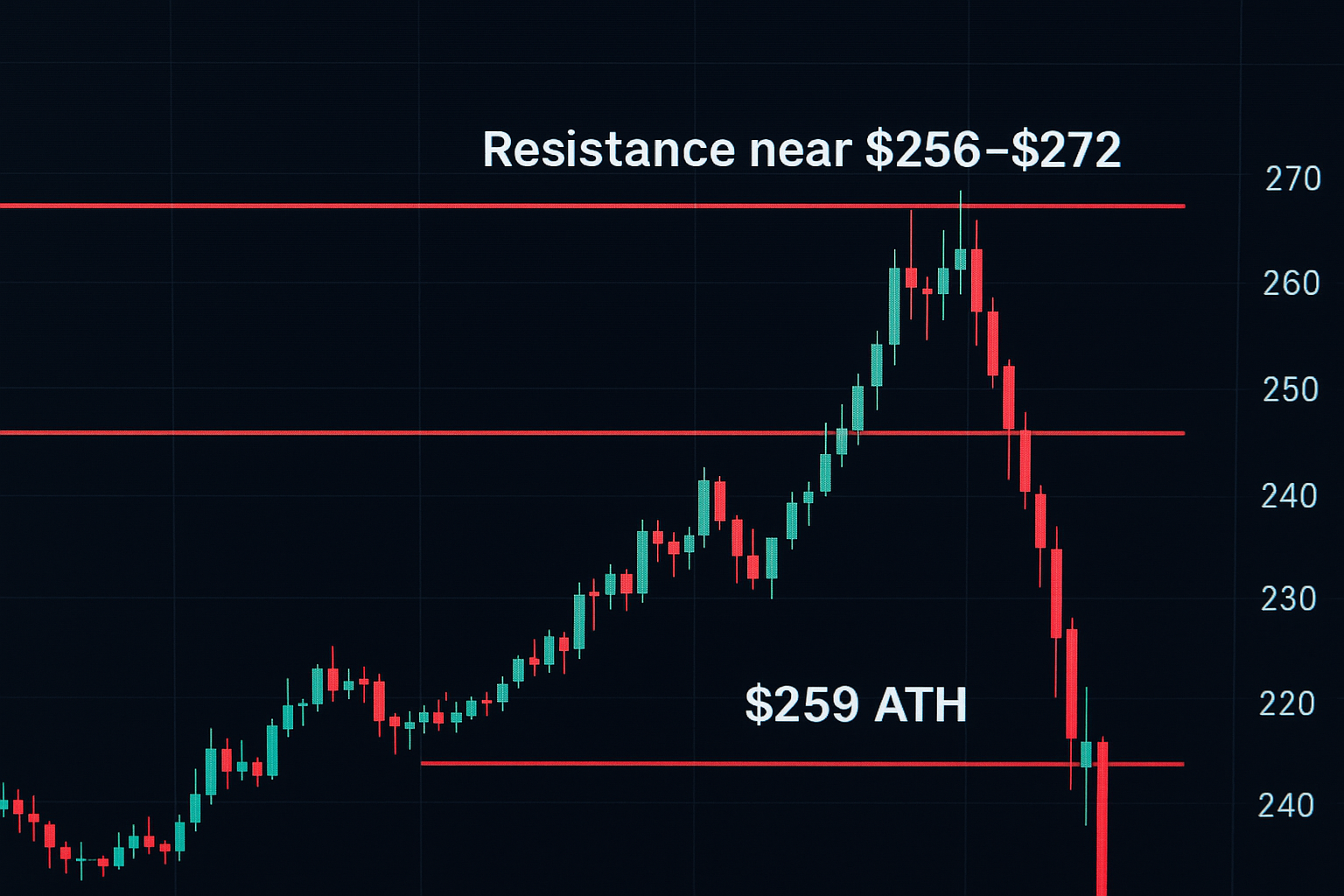
Solana’s immediate challenge lies in breaking the $256–$272 range. This zone aligns with its former all-time high of ~$259, making it a critical resistance area. If Solana can close above this level, the path toward $300 becomes much clearer. Technical traders are closely watching this region, as a breakout could trigger a surge of momentum buying.
3. Overextension Warning
Despite the bullish outlook, it’s important to recognize that Solana’s price has moved sharply above its fast-moving averages. This suggests the market could face a short-term pullback or consolidation phase before attempting the next leg higher. Healthy corrections often strengthen the long-term trend by shaking out weak hands.
4. Capital Rotation
One of the most powerful drivers behind Solana’s rally is the capital rotation from Bitcoin into altcoins. As Bitcoin’s dominance declines, money flows into high-performing alternatives like Solana. What makes this trend even more notable is that Solana is also outperforming Ethereum, showing that investors are seeking exposure to assets with higher growth potential.
5. Stablecoin Dominance Falling
Stablecoin market share has been declining, which usually means investors are moving money out of cash-like holdings and into riskier assets. This shift benefits Solana directly, as it becomes one of the main destinations for inflows seeking higher returns.
6. Solana vs Ethereum
In the battle of smart contract platforms, Solana is beginning to shine. With faster speeds, lower fees, and growing developer adoption, Solana is increasingly being seen as a strong alternative to Ethereum. This relative strength is one reason why Solana continues to outperform ETH in recent months.
7. Cycle Pattern Confirmation
Crypto markets often follow a predictable cycle: Bitcoin rallies first, Ethereum follows, and then altcoins enjoy their run. Solana’s rise fits neatly into this pattern, signaling that it could still be in the early stages of its altcoin cycle surge.
8. Cautionary Note
While the outlook is bullish, investors must remember that Solana, like all altcoins, is highly volatile. Sharp corrections are part of the game. Having realistic expectations and risk management strategies is essential for navigating this rally.
Solana Elliott Wave Technical Analysis – Price Update
Solana’s price action is aligning closely with Elliott Wave theory, which helps explain both the pullbacks and the potential for much higher prices ahead.
Resistance Tested
Solana recently tested the $250 resistance zone. This aligns with the broader Elliott Wave roadmap, suggesting that the asset is still in a healthy uptrend despite short-term pauses.
Wave Count Structure
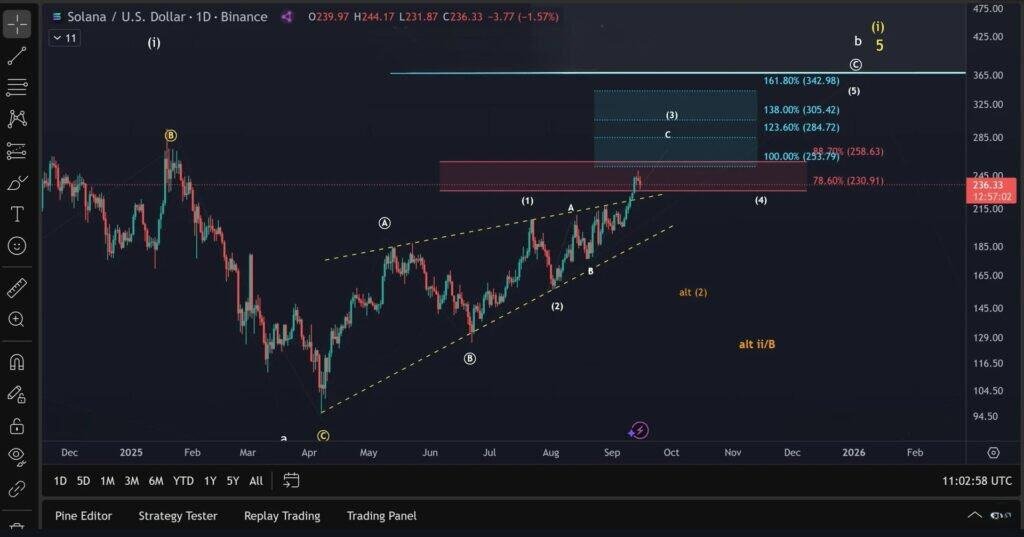
- Current rally = Wave 3 of a larger structure
- Ongoing pullback = Wave 4 correction
- Expected next move = Wave 5 rally, targeting $360–$380
Wave Four Support Zone
- $217–$236 is the critical support region
- 38.2% Fibonacci retracement = ~$229 (already tested near $232)
- 50% Fibonacci retracement = ~$223
- Trendline support also intersects this region, making it a strong zone for buyers
Critical Risk Level
If Solana breaks below $217 decisively, the bullish Elliott Wave structure could be invalidated, signaling a deeper correction. However, as long as this level holds, the bullish outlook remains intact.
Market Structure & Pullback Nature
The current downside appears to be a three-wave correction, typical of a wave four pullback. This supports the idea that Solana is simply pausing before the next major leg higher.
Medium-Term Outlook

- Above $217 = bullish continuation likely
- Next target = $300, with potential extension to $360–$380 in 2025
Fundamental Drivers Behind Solana’s Growth
Network Strength
Solana boasts transaction speeds far beyond Ethereum, handling thousands of transactions per second with extremely low fees. This scalability makes it attractive for developers building DeFi, NFTs, and Web3 applications.
Ecosystem Expansion
From gaming projects to DeFi protocols, Solana’s ecosystem is booming. Major partnerships and integrations are driving adoption across industries.
Institutional Interest
More hedge funds and institutional investors are adding SOL USD to their portfolios. This trend adds long-term stability and reduces the likelihood of complete collapse during market downturns.
Developer Community
Solana’s developer community continues to grow rapidly, with thousands of new projects launching every year. A thriving developer base is critical for sustaining long-term growth.
Risk Factors to Watch
Even though Solana looks strong, investors should keep an eye on potential risks:
- Regulatory hurdles: Governments are still defining crypto rules, which could affect Solana’s adoption.
- Network stability: Past network outages highlight that Solana needs to keep improving infrastructure.
- Macro conditions: Global economic uncertainty and Federal Reserve policies could impact crypto inflows.
- Competition: Ethereum, Avalanche, and other smart contract platforms are still major competitors.
Conclusion
The case for Solana breaking above $300 in 2025 is supported by both technical and fundamental factors. With capital rotation into altcoins, strong adoption, and a bullish Elliott Wave setup, the SOL coin price prediction remains firmly upward. While volatility is guaranteed, the overall trend points toward significant gains, making Solana one of the most exciting crypto assets to watch in the coming year.
FAQs
1. What is the current SOL USD price trend?
Solana is in a bullish trend, consolidating between $217 and $236 support before targeting $300 and higher.
2. Can Solana hit $300 in 2025?
Yes, technical analysis and fundamental drivers suggest Solana could break $300 and potentially move toward $360–$380.
3. What is the Sol coin price prediction for 2025?
Analysts see Solana reaching between $300 and $380 if key support levels hold.
4. Why is Solana pumping right now?
Solana is gaining from capital rotation, declining stablecoin dominance, and outperforming Ethereum in speed and adoption.
5. Is Solana better than Ethereum?
While Ethereum remains dominant, Solana offers faster transactions and lower fees, making it attractive for developers.
6. What resistance levels must Solana break?
The main resistance lies between $256–$272, with a breakout above $259 being critical.
7. What happens if Solana falls below $217?
A break below $217 would weaken the bullish Elliott Wave structure and could trigger deeper corrections.
8. How does Elliott Wave analysis apply to Solana?
Solana is currently in a wave four correction, with a potential wave five rally pushing it above $360.
9. Why is stablecoin dominance important for Solana?
When stablecoin dominance falls, money moves into risk assets like Solana, boosting prices.
10. What risks should Solana investors consider?
Network outages, regulatory changes, and macroeconomic shifts are key risks.
11. Is Solana a good investment in 2025?
If you believe in long-term blockchain adoption, Solana presents strong upside potential.
12. How does Solana compare to other altcoins?
Solana is outperforming Ethereum and many other altcoins in both adoption and market strength.
13. Can Solana reach $500 in the future?
While $300–$380 is the immediate target, a long-term rally could push Solana toward $500 if adoption accelerates.
14. How volatile is Solana?
Like all altcoins, Solana is prone to sharp corrections, but the overall trend remains bullish.
15. What is Solana dominance in the market?
Solana’s dominance has increased significantly, reflecting its growing share of crypto inflows
16. What role does Bitcoin dominance play?
As Bitcoin dominance declines, capital often flows into high-growth altcoins like Solana.
17. How do Fibonacci retracements affect Solana?
Key retracement levels at $229 and $223 provide strong support zones for buyers.
18. What industries are building on Solana?
DeFi, NFTs, gaming, and Web3 projects are expanding rapidly on Solana.
19. Is Solana safe from regulation?
No crypto is fully safe from regulation, but Solana is working toward compliance and institutional adoption.
20. Should traders expect corrections before $300?
Yes, short-term corrections are likely, but the medium-term outlook remains bullish above $217.
________________________________________________________________________________________________________________
Stay ahead in the world of Solana and cryptocurrency by connecting with us! Whether you’re a new investor, developer, or crypto enthusiast, we provide regular updates, market insights, SOL USD analysis, and educational resources to help you make informed decisions. Subscribe to our newsletter, join our community discussions, or reach out directly for personalized guidance. Let us help you stay informed, track Solana’s latest trends, and navigate the exciting opportunities in the crypto space.