

Top 8 AI Trend-Analysis Tools for Futures Trading Decisions
AI trend-analysis tools for futures trading decisions in 2025 are advanced platforms that use machine learning, predictive analytics, and real-time insights market data to help traders identify patterns, forecast price movements, and manage risks in futures contracts.
Quick Answer
The best AI trend-analysis tools for futures trading decisions help traders identify price patterns, detect market momentum, and predict short-term or long-term contract movements using machine learning and real-time data. The top 8 tools in 2025 are: TrendSpider, Trading Technologies (TT), QuantConnect, MetaTrader 5 with AI plugins, Capitalise.ai, Kavout, Darwinex, and EquBot. These platforms use advanced algorithms, deep learning, and predictive analytics to give futures traders data-driven insights, reduce emotional bias, and improve decision-making.

Why AI Matters in Futures Trading
Futures markets move fast. Traders need to spot trends before they fade. Traditional chart reading and technical analysis rely on human interpretation, which can be slow and subjective.
AI trend-analysis tools change the game by:
- Scanning millions of price points instantly
- Detecting patterns invisible to humans
- Learning from historical and real-time data
- Removing emotions from trading decisions
This makes them ideal for futures traders looking for a competitive edge.
How AI Trend-Analysis Tools Improve Futures Market Predictions
AI trend-analysis tools for futures trading decisions combine trend forecasting models, AI-powered backtesting, and real-time sentiment analysis to deliver actionable insights. Instead of relying only on moving averages or candlestick signals, these platforms apply quantitative trading strategies and adaptive machine learning to separate noise from meaningful moves. The result: traders can better judge if a price shift is a temporary fluctuation or the start of a major trend. By applying AI trend-analysis tools for futures trading decisions, traders can filter noise and improve their contract forecasts
Reducing Trading Risks with AI Trend-Analysis Tools
One of the greatest benefits of AI in futures trading is risk reduction. Futures contracts carry leverage, meaning even small market swings can lead to big losses. AI tools analyze order flow prediction data, macroeconomic signals, and market sentiment analysis to detect hidden risks before they materialize. This allows traders to set smarter stop-losses, hedge effectively, and avoid high-risk entry points. By combining technical vs. fundamental AI analysis, traders can strike the right balance between profit potential and long-term sustainability.Effective use of AI trend-analysis tools for futures trading decisions allows traders to manage leverage risks more effectively
The 8 Best AI Trend-Analysis Tools for Futures Trading
1. TrendSpider – Automated Pattern Recognition

What it is: TrendSpider is an AI-powered charting platform that acts like an automated trend forecasting model.
Why it’s great for futures trading: It saves time by auto-detecting candlestick patterns, trendlines, and support/resistance zones. Futures traders also benefit from its AI-powered backtesting engine, which tests strategies across decades of historical data.
Key Features:
- Automated pattern recognition
- Multi-timeframe analysis
- Market sentiment analysis overlays
- Backtesting engine
Pricing: Starts at $44/month.
Pros:
- Speeds up technical analysis
- Reliable data-driven futures contracts testing
- Helps filter false breakouts
Cons:
- Learning curve for advanced features
- Some premium tools cost extra
Use Case: A crude oil futures trader might use TrendSpider’s backtesting + sentiment tools to confirm whether a breakout reflects real demand or speculative volatility.
Best for: Futures traders seeking AI trading bots for futures that reduce emotional decision-making.
2. Trading Technologies (TT) with AI Analytics

What it is: Trading Technologies is a professional futures platform widely used by institutions and prop firms.
AI Features: Advanced order flow prediction and quantitative trading strategies powered by ML algorithms.
Why traders use it: TT offers AI-powered backtesting and market replay tools, enabling futures traders to test strategies in real conditions before going live.
Pricing: Enterprise-level pricing (higher than retail platforms).
Pros:
- Deep liquidity analysis (CME, ICE, Eurex)
- Professional-grade execution and risk controls
- Robust trend forecasting models
Cons:
- Expensive for retail traders
- Requires advanced knowledge
Use Case: A futures desk at a prop firm may rely on TT to predict large institutional order book imbalances, then deploy AI trading bots to capitalize automatically.
Best for: High-frequency traders and professional futures desks.
3. QuantConnect – Algorithmic Futures Trading with ML

What it is: An open-source algorithmic trading platform for quants and developers.
AI Edge: Allows traders to design, train, and deploy machine learning models for futures contracts using Python, C#, and TensorFlow.
Why it works: Supports quantitative trading strategies at scale, with access to massive historical datasets for futures markets.
Key Features:
- AI-powered backtesting engine
- Cloud-based algorithm testing
- Integration with ML libraries
Pros:
- Free to start, flexible framework
- Supports multiple asset classes
- Strong community support
Cons:
- Requires coding knowledge
- Complex for beginners
Use Case: A trader could train an ML model to forecast E-mini S&P 500 futures trends using market sentiment analysis and order flow prediction.
Best for: Quants, coders, and systematic traders who want data-driven futures contracts strategies.
4. MetaTrader 5 with AI Plugins

What it is: A widely used multi-asset platform enhanced with AI trading bots for futures via plugins and Expert Advisors (EAs).
Why it’s powerful: Combines ease of use with advanced automation, letting retail traders deploy technical vs. fundamental AI analysis in futures markets.
Key Features:
- AI-enabled Expert Advisors (EAs)
- Automated chart recognition
- AI-powered backtesting support
Pros:
- Retail-friendly interface
- Huge library of AI plugins
- Low entry barrier
Cons:
- Requires add-ons for advanced AI features
- Risk of poorly coded EAs
Use Case: A trader could automate a trend forecasting model that buys micro futures contracts only when both technical and news-based sentiment align.
Best for: Retail traders experimenting with AI trend-analysis tools for futures trading decisions.
5. Capitalise.ai – No-Code AI Futures Trading

What it is: A no-code platform where traders can write strategies in plain English.
AI Highlight: Uses natural language processing to automate quantitative trading strategies without programming.
Why it helps futures traders: Lowers barriers by allowing strategy creation like: “Buy Gold futures if RSI < 30 and sentiment is positive.”
Pros:
- Beginner-friendly
- Supports market sentiment analysis
- Integrates with brokers
Cons:
- Limited customization for advanced quants
- Dependent on broker support
Use Case: A beginner trader might use Capitalise.ai to create a simple order flow prediction strategy for CME futures without writing a single line of code.
Best for: New traders entering futures with AI trading bots and automation.
6. Kavout – AI Stock & Futures Analytics
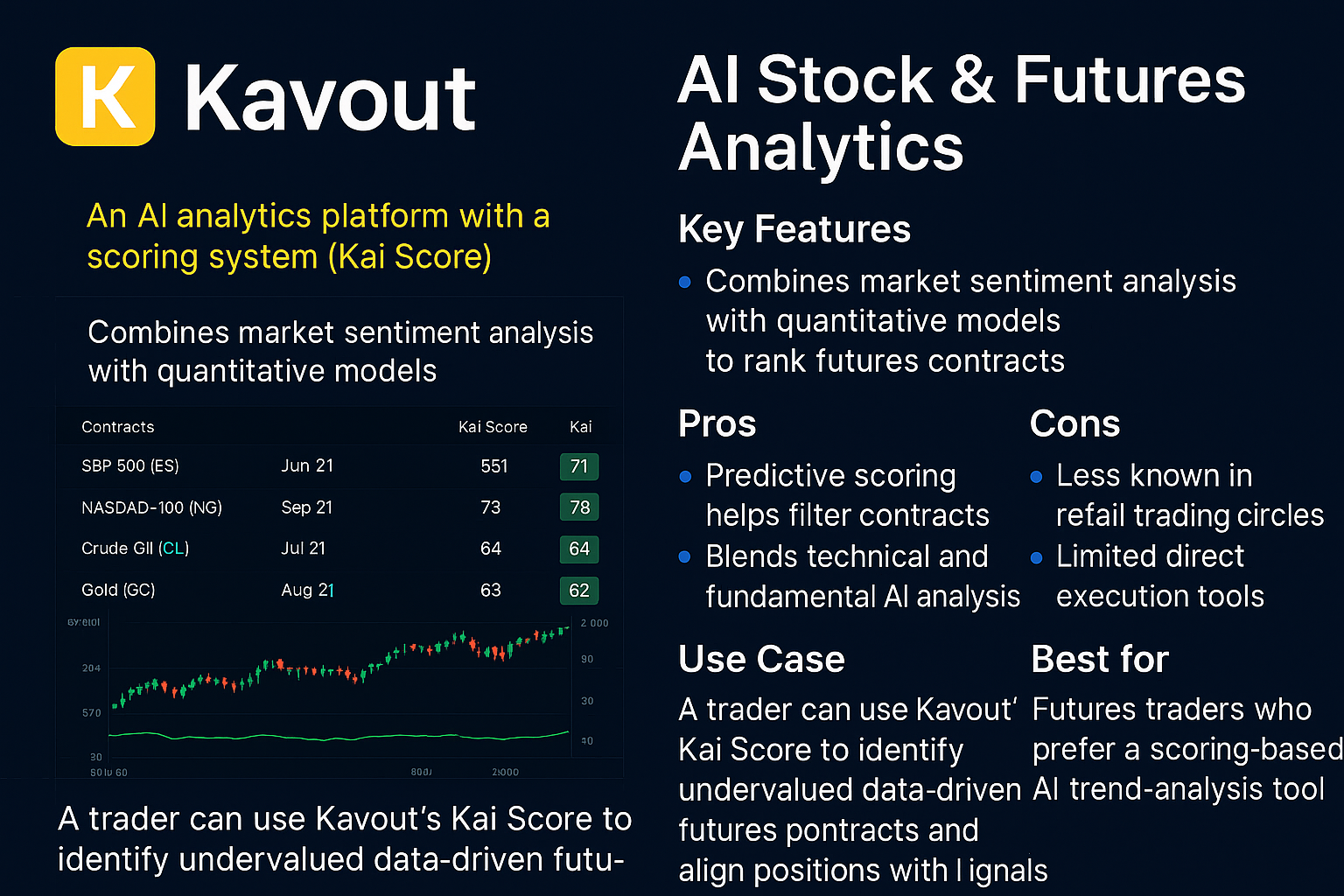
What it is: An AI analytics platform with a scoring system (Kai Score).
AI Advantage: Combines market sentiment analysis with quantitative models to rank futures contracts.
Pros:
- Predictive scoring helps filter contracts
- Blends technical and fundamental AI analysis
- Useful for portfolio-level futures management
Cons:
- Less known in retail trading circles
- Limited direct execution tools
Use Case: A trader can use Kavout’s Kai Score to identify undervalued data-driven futures contracts and align positions with AI signals.
Best for: Futures traders who prefer a scoring-based AI trend-analysis tool.
7. Darwinex – Crowd-Sourced AI Strategy Evaluation

What it is: A platform where AI evaluates trading strategies and assigns scores.
AI Strength: Helps futures traders validate systems with third-party metrics like risk-adjusted returns.
Pros:
- Transparency with quantitative trading strategies
- AI-driven scoring ensures accountability
- Community-based sharing of ideas
Cons:
- Limited direct futures trading features
- More evaluation than execution
Use Case: A trader could test a futures strategy based on order flow prediction, then use Darwinex to validate its robustness before going live.
Best for: Semi-pro traders who want AI-powered backtesting + peer validation.
8. EquBot – AI for Futures ETFs and Beyond

What it is: An AI engine originally used in ETFs, now applied to futures analysis.
AI Edge: Uses NLP + predictive analytics to interpret global news and market sentiment.
Pros:
- Excellent for macro-driven futures markets
- Blends technical vs. fundamental AI analysis
- Automated trend forecasting models
Cons:
- Not tailored exclusively to futures
- Requires integration for execution
Use Case: A trader tracking global events could use EquBot to spot futures trends in commodities like wheat or oil influenced by geopolitical shifts.
Best for: Traders combining fundamentals with AI-driven technical insights.
Final Thoughts
AI trend-analysis tools for futures trading decisions are no longer optional—they’re essential for staying competitive. By combining AI-powered backtesting, market sentiment analysis, trend forecasting models, and order flow prediction, traders gain a decisive edge. Whether you’re a retail trader using Capitalise.ai or an institutional desk with Trading Technologies, the future of futures trading is data-driven, AI-assisted, and strategy-focused.This is why many traders are turning to AI trend-analysis tools for futures trading decisions to gain a competitive edge
FAQs – AI Trend-Analysis in Futures Trading
Q1. What is the best AI tool for futures trading beginners?
Capitalise.ai is beginner-friendly because it allows plain-English strategy building.
Q2. Can AI predict futures market trends accurately?
AI tools use trend forecasting models and quantitative trading strategies to improve accuracy, but no system is 100% perfect.
Q3. Are AI futures trading tools expensive?
Some are affordable (TrendSpider ~$44/month), while institutional platforms like Trading Technologies cost more.
Q4. Do I need coding to use AI in futures trading?
No. Tools like Capitalise.ai and TrendSpider don’t require coding. QuantConnect does.
Q5. Will AI replace futures traders?
AI trading bots for futures won’t replace human traders but will enhance decision-making and reduce emotional bias.
Q6. How does market sentiment analysis improve futures trading?
It detects whether futures moves are supported by real demand or speculation, helping traders avoid false signals.
Q7. Why is AI-powered backtesting important in futures?
It allows traders to test strategies on decades of historical data-driven futures contracts, ensuring reliability before risking capital
Feel free to get in touch to explore proven trading techniques and practical strategies— the right knowledge can transform the way you trade